
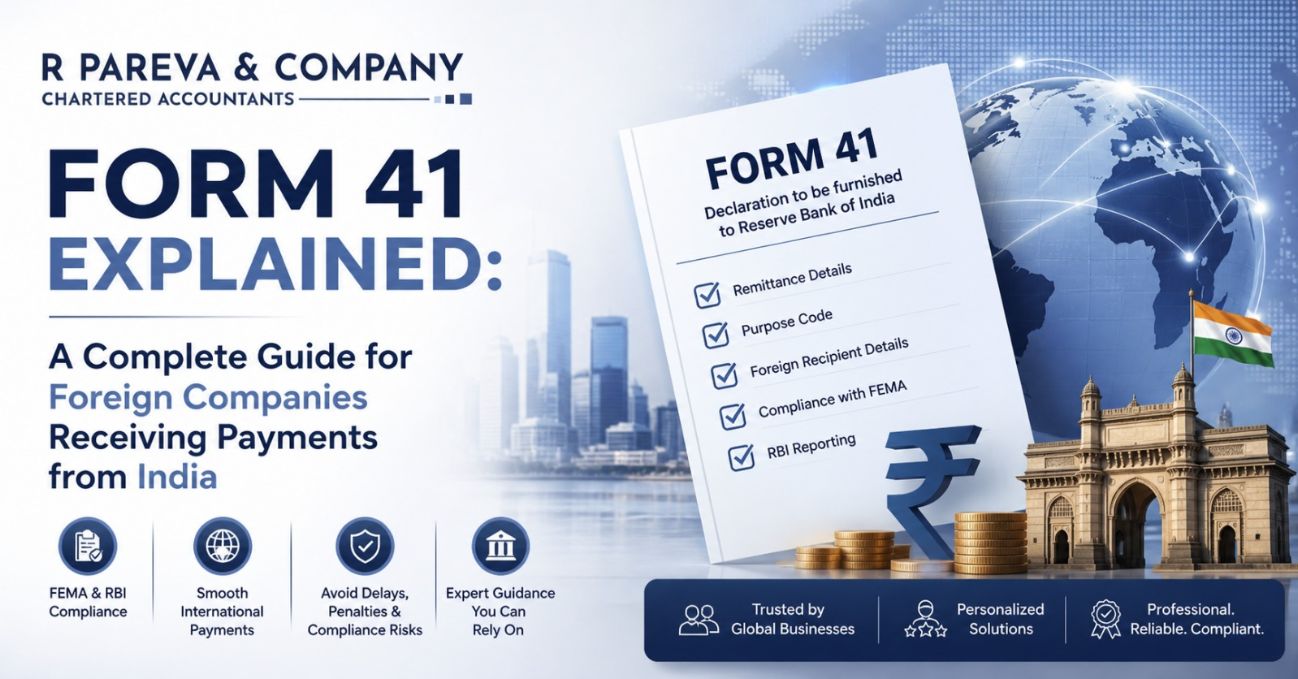
If you've been receiving income from India — dividends, royalties, fees, interest — and you've been claiming treaty benefits using Form 10F, there's something you need to address right now. That form doesn't exist anymore.
India’s new Income Tax Act came into force on 1st April 2026. It’s not just a set of amendments — it’s a full rewrite of the law that’s governed Indian taxation since 1961. And with it came a new form: Form 41 income tax filers and non-residents must now use — replacing Form 10F entirely.
We've had a lot of clients ask us about this over the past few months. This article covers what's actually changed, what you need to do, and what happens if you don't.
When comparing Form 10F vs Form 41, the purpose is identical — you’re filing it to claim reduced or nil withholding tax on income received from India under a Double Taxation Avoidance Agreement (DTAA). But the form number, the legal provisions it references, and the way it’s filed have all changed under ITA 2025. To answer the question many are asking — yes, Form 10F is discontinued and Form 41 is its mandatory replacement.
If your team has been auto-renewing Form 10F every year without thinking about it, that process needs to change. A common question we hear is: is Form 10F still valid in 2025 or beyond? The short answer: it is not — and if you’re unsure whether to file Form 10F or Form 41, the answer is always Form 41 now. A Form 10F filed for the old Assessment Year 2026-27 does not cover you for Tax Year 2026-27 under the new Act. These are different filings under different laws.
This one's actually a relief. Under the old Act, your income was earned in a "Financial Year" but taxed in an "Assessment Year" — so the same cycle had two different names depending on what you were talking about. FY 2024-25 and AY 2025-26 referred to the same income, just from different angles. It confused everyone.
ITA 2025 scraps that. There's now just one label: the Tax Year. Right now, we're in Tax Year 2026-27, covering 1st April 2026 to 31st March 2027. When you're corresponding with Indian banks, payers, or the tax department, use that language. Don't say FY or AY — it'll only create confusion during a transition period where both systems are still being referenced.
Your Tax Residency Certificate — issued by your home country's tax authority — is the primary document that establishes your eligibility for DTAA benefits. It proves you're a tax resident of the treaty country.
The problem is that most TRCs don't contain everything India's tax law requires. Information is missing. Form 41 is the self-declaration you file to provide that missing information directly to the Indian tax authority.
Without it, your TRC alone isn't sufficient. Even if your treaty clearly entitles you to a lower rate, your Indian payer cannot apply that rate unless Form 41 is on record.
Anyone receiving income from India and claiming DTAA protection will almost certainly need Form 41. For NRIs in India’s tax framework, Form 41 is now the standard compliance document. This includes NRIs and PIOs receiving dividends, interest, royalties, or capital gains from Indian sources. It includes foreign companies earning technical fees, business income, or ECB interest from India. It covers Foreign Portfolio Investors, foreign nationals on work assignments in India, and overseas holding companies receiving inter-company charges from Indian subsidiaries.
If your income from India is covered by a treaty and you want that treaty to actually apply, Form 41 is how you make that happen.
Form 41 is a self-declaration — you sign it, not your home country's tax authority. It asks for your name and legal status, your nationality or country of incorporation, your Indian PAN if one has been allotted, your tax identification number in your home country, the validity period of your TRC, your registered address abroad, and your contact details.
That's it. It's not a complicated form. The complication comes from the timing.
Form 41 is filed on India's Income Tax Portal (www.incometax.gov.in). If you don't have an Indian PAN, you can register using your foreign Tax Identification Number.
The critical thing is timing. The form must be filed before your Indian payer processes the payment. That's how they know which TDS rate to apply. If it's filed after the money has already moved, the higher rate has already been deducted — and now you're looking at a refund process, which means filing an Indian income tax return and waiting.
Form 41 is valid for one Tax Year. File it fresh every year, ideally at the start of April.
One thing worth flagging: if your TRC runs on a calendar year — January to December — it doesn't cover the full Indian Tax Year. A TRC for January–December 2026 covers only up to December 2026. You'll need a second TRC for 2027 to cover January through March 2027, along with a second Form 41. This catches people out more than almost anything else.
Without a valid Form 41 and TRC, your Indian payer is legally required to deduct TDS at the maximum applicable rate — often between 20% and 40%. Your treaty entitlement doesn't help you if the paperwork isn't in order.
Beyond the higher deduction, there's a real risk of your DTAA claim being denied altogether, meaning you're taxed on the same income in both countries. Recovering excess TDS means filing an Indian return — it can be done, but it takes time and effort that's easily avoided.
Incorrect or false information in Form 41 carries its own risk: penalties under ITA 2025 and potential scrutiny. It's not a form to rush through.
Q1. Our income is fully exempt under the treaty. Do we still need to file?
Ans: Yes. The exemption doesn't apply automatically — it has to be claimed, and Form 41 is part of that claim. Without it, your payer will deduct at the standard rate regardless of what the treaty says.
Q2. We don't have an Indian PAN. Can we still file?
Ans: Yes, using your foreign Tax ID. But if you regularly receive income from India, it's worth getting a PAN — it makes the whole process considerably smoother.
Q3. Can our Indian subsidiary handle the filing for us?
Ans: No. It's your declaration to make. Your subsidiary can help with coordination, but the filing itself requires your signature, or that of a duly authorised representative with a power of attorney.
Q4. TDS was already deducted at the higher rate on a recent payment. Now what?
Ans: You'll need to file an Indian ITR for Tax Year 2026-27 to claim the refund. For future payments, we'd suggest applying for a lower withholding certificate proactively — it avoids this situation entirely. We help clients with both.
Get a valid TRC that covers Tax Year 2026-27. If your TRC is calendar-year based, check whether you need a second one to cover January–March 2027. File Form 41 on the portal before the payment is processed. Confirm your PAN is active, or register with your foreign TIN. Send copies of both documents to your Indian payer. And set a reminder to do this again next April — it's an annual requirement.
R Pareva & Company, Chartered Accountants works with NRIs, foreign companies, and global investors on international tax compliance, DTAA advisory, and cross-border structuring for India. If you're working through any of the above, we're happy to help. Contact us at info@rpareva.com

Contact us