
India’s foreign trade environment has seen unprecedented growth in the past few years, with new startups exporting software services, consultants receiving payments from international clients, manufacturers shipping goods to international clients, and foreign companies setting up their subsidiaries in India in record numbers.
But with this growth comes the corresponding responsibility of foreign exchange compliance under FEMA.
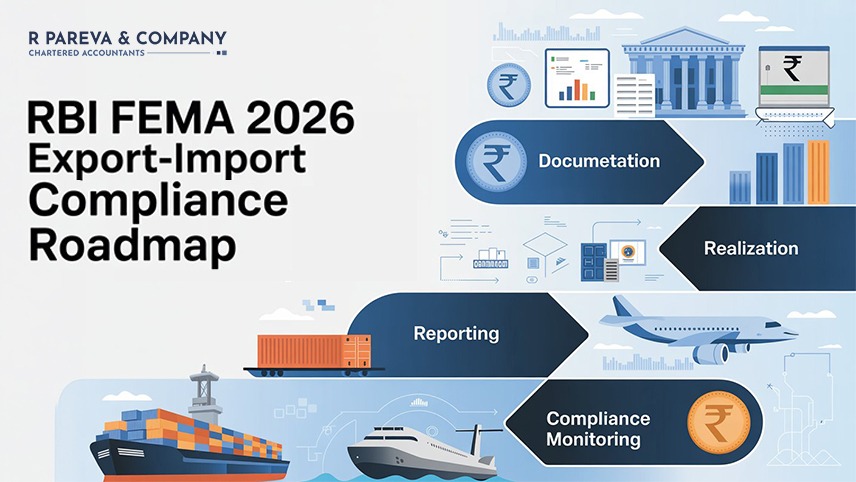
In order to simplify and modernize India’s foreign trade environment, the Reserve Bank of India has introduced the Foreign Exchange Management (Export and Import of Goods and Services) Regulations, 2026, which consolidates the various foreign trade regulations in India. These regulations will come into effect from 01st October, 2026.
While the intention of the new FEMA 2026 Export-Import Regulations may have been to simplify the foreign trade environment in India, the reality is starkly different, with non-compliance easier to identify than ever, and penalties for non-compliance stricter than ever.
For exporters, service providers, startups, SMEs, and foreign companies operating in India, FEMA compliance is no longer a back-office activity but has assumed the importance of a core governance activity that has a direct bearing on banking operations, remittances, and overall business operations.
Until the introduction of the FEMA 2026 Export-Import Regulations, FEMA export-import compliance was a very cumbersome and confusing affair, with exporters and service providers having to deal with various forms such as the SOFTEX Form, EDF, GR, and different standards of reporting, depending on whether they export goods, software, or services.
In addition, banks had varying interpretations of the FEMA export-import regulations, with very strict guidelines and no flexibility in terms of the timeline, and service exporters were even unaware of the applicability of FEMA to their export services until the introduction of the FEMA 2026 Export-Import Regulations, which have addressed the various issues faced by exporters and service providers in India by introducing the following reforms:
In a nutshell, FEMA is moving from a paperwork-based model to a real-time model of monitoring and accountability.
This makes it easier to comply with regulations, yes, but also much more transparent and traceable.
The first major change is the introduction of a unified export declaration mechanism.
In the previous model, different types of exports were required to be declared separately. Goods exports were done through EDF, software exports were done through SOFTEX, and service exports were in a gray area in most cases, which led to widespread non-compliance with regulations.
The new model has a unified structure for export declarations.
This is a big positive change for businesses: fewer forms to fill, less bureaucratic hurdles to cross, faster turnaround time with banks.
But it also means something important: every export is now traceable.
If funds are received without proper declaration or reporting, it now triggers a bank inquiry immediately. So, it is essential to ensure that invoices, declarations, and remittances are perfectly aligned with each other.
The second major change is the rationalization of timelines in export realization.
In the previous model, rigid timelines were in place, which led to widespread cases of ‘technical violations’ even when the delays were commercially valid. With the new model, AD banks have more discretion to grant extensions in a legitimate case.
This is a big positive change for businesses: more time to realize exports, less likelihood of technical violations, and more scope to negotiate with clients.
This is especially useful in cases of:
However, this should not be misconstrued as a relaxation in regulations: banks are now more vigilant than ever.
If the export proceeds are not realized within the stipulated time period without any documentation or extension, it can lead to FEMA contravention.
An export ageing tracker and reconciliation are becoming the need of the hour, not just best practices.
India is becoming a service-oriented economy, but FEMA compliance and regulations have traditionally been biased towards the export of goods.
This led many freelancers, start-ups, and digital businesses to believe that if the money is automatically credited to the account without any issue, then FEMA regulations do not apply.
This is not true.
Finally, the regulations of 2026 recognize the export of services and make it a part of the FEMA regulations, just like the export of goods.
This is applicable to:
If you are invoicing your clients and receiving foreign exchange, then you are an exporter and are required to comply with FEMA regulations.
This is an area where many small and mid-sized businesses are unknowingly putting themselves at risk.
Merchanting Trade Transactions (MTT), or the purchase of goods from one country and selling the same to another country without the involvement of India, is a complex and heavily regulated area.
This is now made easier and more practical with the new regulations.
This is applicable to and will benefit:
However, the settlement and documentation of such merchanting transactions are required to be done properly. Otherwise, FEMA violations can be levied.
Professional structuring is advisable for such models.
The most practical change is the enhanced role of the AD Banks.
The role of the bank has changed from being a simple remittance channel to being the first line of enforcement of FEMA regulations.
The bank can:
This brings us to the important role of the banking relationship.
The banking relationship is now crucial for businesses.
Businesses need to respond promptly to queries and ensure documentation is transparent. Any casual or delayed response can turn into a compliance issue.
How should businesses respond to the changing FEMA regulations?
The answer is not complicated, but the process demands discipline.
The first step is to understand if the business has any foreign exchange exposure. If the business exports goods, provides services outside India, or receives foreign currency, or imports services or software, then FEMA regulations apply to the business.
The next step is to establish strong documentation processes. Businesses need to have contracts, invoices, shipping documents, foreign inward remittance certificates, and bank reconciliation statements.
The third step is to establish periodic reviews. Quarterly health checks for FEMA can help businesses identify issues before they turn into violations. Many businesses realize the mistake only when the bank flags the issue.
The fourth step is to align the processes. Accounting and ERP systems should have automatic tracking of exports, realization of exports, and due dates. Manual tracking can result in errors.
FEMA compliance needs to become an integral part of the business processes, not an end-year exercise.
However, many exporters do not file declarations. Some may even receive money in personal accounts or ignore delayed realization or bank communication. Even merchanting trades may be entered into without any regulatory understanding.
This is not a minor oversight. Under the FEMA Act, even minor violations may result in a penalty of an amount that is three times the transaction involved, along with compounding proceedings.
Preventive compliance is always easier and less expensive than corrective compliance after a violation.
Foreign companies that have set up subsidiaries in India face an even greater challenge due to the interplay between the FEMA Act, company laws, GST laws, and transfer pricing laws. Foreign companies that charge for cross-border services, royalty, reimbursement, etc., have to be carefully structured so that they do not run into both tax and FEMA violations. An integrated approach that combines both FEMA and international tax planning is essential for such companies. How R Pareva & Company (RPC) Helps Businesses R Pareva & Company (RPC) is committed to helping exporters, startups, NRIs, and even foreign investors comply with the FEMA Act.
Our experts help businesses:
The idea is simple: facilitate smooth business for our clients without any regulatory hurdles. Refer our service page FEMA and RBI Compliance in India and explore more.
The FEMA Export-Import Regulations 2026 mark an important milestone in the modernization of India's exchange control regime. It is now simpler, faster, and digital. It is also more transparent and accountable. Businesses that comply with the regulations will benefit from smooth banking and rapid cross-border transactions. Those that do not may suffer disruptions and face violations. So, if your business involves any exchange of foreign currency, now is the right time to review your FEMA compliance. Why? Because in today's world, compliance is not a cost; it is a competitive advantage.

Contact us